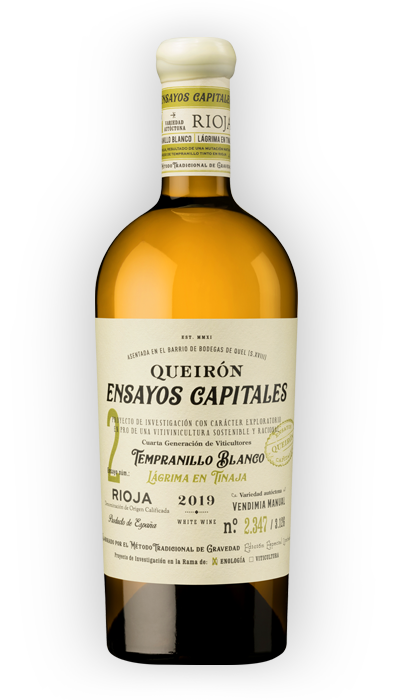



Tempranillo
Blanco
A natural mutation
born in Rioja Oriental
Tempranillo Blanco stands as a powerful emblem of Rioja’s unique identity, for it is an exclusive variety found nowhere else beyond our Denominación de Origen Calificada.
In 1988 (with propagation beginning in 1989), a grower named Jesús Galilea Esteban—affectionately known as “Jario”—spotted an extraordinary anomaly in one of his old Tempranillo vines in the village of Murillo de Río Leza, deep in Rioja Oriental: a single shoot bearing a cluster of golden-yellow berries amid the expected dark-skinned fruit. He carefully pruned away the mutant bunch, preserving the anomalous cane. That decisive act sparked the birth of a wholly Riojan variety—100% indigenous to our region.
From the buds of that mutated shoot, researchers at the CIDA (now part of the Instituto de Ciencias de la Vid y del Vino – ICVV) propagated and rigorously evaluated the new clone. After years of study confirming its stability, agronomic viability, and enological promise, Tempranillo Blanco was officially incorporated into the DOCa Rioja varietal catalogue in 2008.
Today, this dynamic white sibling of red Tempranillo has seen enthusiastic adoption across the appellation, with plantings now approaching or exceeding 800 hectares—making it the second most planted white variety in Rioja after Viura.
A team of scientists at the ICVV has since elucidated the genetic mechanism behind this remarkable transformation: complex genomic rearrangements following the pattern of a natural chromothripsis event—a massive, catastrophic fragmentation and chaotic reassembly of chromosomes during plant cell division. In this case, the process selectively deleted or disrupted key genes responsible for anthocyanin biosynthesis in the berry skin, resulting in the loss of pigmentation and the emergence of white berries from a red-skinned parent vine.
Tempranillo Blanco thus delivers whites of distinctive aromatic intensity (tropical fruits, citrus, subtle floral notes), elevated malic acidity for freshness and backbone, notable phenolic structure and textural grip, and impressive ageing potential—qualities that underscore its role in Rioja’s vibrant white wine renaissance.
Natural mutation
Tempranillo Blanco traces its origins to a natural mutation first detected in a vineyard in Murillo de Río Leza (DOCa Rioja / Rioja Oriental) toward the end of the 1980s. From the buds of that mutated shoot, a new variety was propagated—one that unlocks exceptional enological potential for white wines and has since expanded to plantings approaching 800 hectares (with recent estimates placing it around 700–800 ha, firmly establishing it as the second most planted white variety in the appellation after Viura).
A research team from the Instituto de Ciencias de la Vid y del Vino (ICVV) pinpointed the genetic cause: intricate genomic rearrangements following the distinctive pattern of chromothripsis—a catastrophic process involving massive chromosomal fragmentation and chaotic reassembly within the plant’s genome. In Tempranillo Blanco, this remodelling resulted in the deletion or disruption of critical genetic information, including key genes responsible for anthocyanin biosynthesis in the berry skin, thereby eliminating pigmentation and yielding white grapes from a red-skinned parent.
The ICVV study revealed that chromothripsis can arise spontaneously during plant growth, particularly in woody, perennially vegetatively propagated species like the vine, which can persist and multiply clonally over centuries without sexual recombination.
Since receiving official authorization in 2008, Tempranillo Blanco has rapidly ascended to become the second-leading white variety by planted surface in DOCa Rioja, a testament to its enthusiastic adoption by growers and wineries across the region. As a direct derivative of red Tempranillo, it inherits many of the parent’s desirable traits: similar morphological features, vigour, phenological behaviour, responses to pests and diseases, and superb adaptation to Rioja’s diverse terroirs and cultivation practices. This close kinship greatly simplifies its management, allowing viticulturists to apply familiar techniques honed over generations for red Tempranillo while unlocking fresh, vibrant white expressions that enrich Rioja’s evolving palette.
Authorized by the Rioja Regulatory Council in 200
As documented in the journal Enólogos, this natural mutation of a Tempranillo Tinto vine—triggered by various environmental factors—was first spotted by Jesús Galilea in an old vineyard of his own property in Murillo de Río Leza (La Rioja), as detailed in a study by the C.I.D.A. (Centro de Investigación y Desarrollo Agrario). On that vine, every spur produced shoots bearing red grapes—except for one anomalous spur that yielded clusters with white berries. In February 1989, drawing on his deep viticultural expertise, Galilea meticulously pruned away the mutant cluster to preserve the spur from which two buds would emerge. This careful intervention marked the starting point for working with this serendipitous material at the Servicio Riojano de Investigación y Desarrollo (Riojan Research and Development Service). The wood was initially planted on its own roots (pie franco) at the Valdegón estate in Agoncillo, and later grafted in the nursery. Subsequently, ten vines were established, which would be incorporated into the C.I.D.A.’s ampelographic catalogue of varieties and rootstocks.
Four years later, after confirming the stability of the young vine’s characteristics—i.e., that the mutation had not reverted—the material was multiplied to reach one hundred plants for comprehensive evaluation of its viticultural behaviour and commercial potential. With the turn of the century, the sole clone of Tempranillo Blanco—notably lacking the intravarietal heterogeneity seen in its red sibling—continued to expand. Between 2000 and 2001, the C.I.D.A. established a one-hectare planting at their own La Grajera estate in Logroño. This milestone effectively marked the legal birth of Tempranillo Blanco, as the project team had meticulously described and documented up to 104 characters according to the O.I.V.’s Code of Descriptive Characters for Varieties and Species of Vitis.
Queirón
con tempranillo blanco
2019