



Graciano
Rioja’s best-kept secret and all of its magic
Graciano is a native, niche variety from Rioja, rarely found beyond its borders. Historically, it has been an essential component in the traditional blends of Rioja’s iconic Grandes Reservas, providing structure and nerve alongside Tempranillo, Garnacha, and Mazuelo. It is a demanding grape for the grower, characterized by low yields, late budding, and an exceptionally long ripening cycle.
The resulting wines are deeply pigmented yet maintain moderate alcohol levels. The must is vibrant, highly aromatic, and marked by a bracing acidity. While its primary profile is exuberant and perfumed, it evolves beautifully with age, developing a distinctive secondary aroma of freshly sawn wood.
Evidence now links Rioja’s Graciano with Parraleta from Somontano and Tintilla de Rota—a rare, high-quality red variety from the Sherry region. As Víctor de la Serna notes, these three grapes, once thought to be isolated and minor varieties, are in fact the same cultivar.
According to Cepas del Mundo, its exact lineage remains elusive. However, records from 1790 suggest that Graciano was once the dominant variety across Navarra and Rioja, particularly in Rioja Alta and the western reaches of Rioja Alavesa, before falling into its current status as a prized rarity.
History
In his work Los vinos de Rioja, Manuel Llano Gorostiza recounts the journey of Manuel Esteban Quintano y Quintano to France during the final decades of the Enlightenment. While studying Bordelais techniques to implement at his estate in Labastida, Quintano noted striking similarities between the vines of Aquitaine and Rioja’s Graciano. Later, in the 19th century, the agronomist Abela would identify the variety even beyond its traditional strongholds in Burgos and Vizcaya.
Juan Marcilla Arrázola, in his 1942 seminal work Tratado práctico de viticultura y enología españolas, argues that the signature bouquet of Rioja is fundamentally shaped by this variety. He posits that Graciano provides the finesse and aromatic elevation within the blend, significantly enhancing the aromatic potential of Tempranillo.
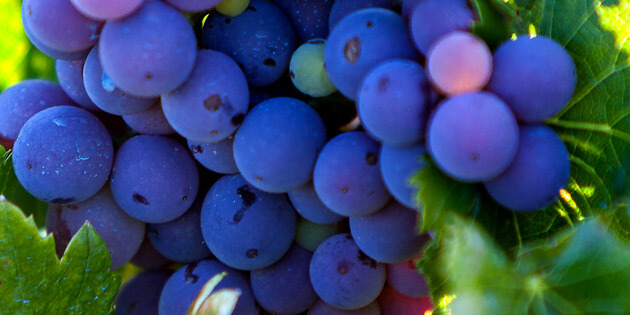
Rubén Pérez Cuevas, winemaker at Queirón, describes Graciano as a decisive family of grapes in Rioja’s history, valued both for its sharp acidity and its ability to round out blends. Despite its demanding nature in the vineyard, its aromatic power is highly compelling. In high-altitude vineyards, such as those in the Sierra de Yerga, it expresses an elegant and refined personality.
From a technical standpoint, Graciano yields wines with a high polyphenolic content, making them ideal for aging. Its aromatic profile is unique, often surpassing other Rioja varieties in intensity. However, it remains a challenge to vinify: the must is fresh and vibrantly red but prone to rapid oxidation. Varietal Graciano wines typically exhibit liquorice notes, a distinct tannic structure, and a slight bitterness, along with a high concentration of pectic substances that can complicate clarification.
Due to its high acidity and phenolic backbone, it is the quintessential grape for crianza. Throughout the world’s ampelographical collections, it is recognized under several synonyms, reflecting its historical spread: Bastardo Nero, Bordelais, Cagnulari, Cagnulari Sardo, Couthurier, Tinta Miuda, Tintilla, and Xerez, among others.
Queirón
with graciano
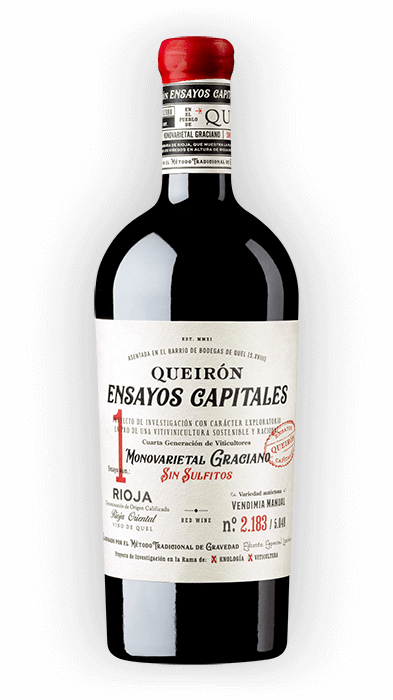
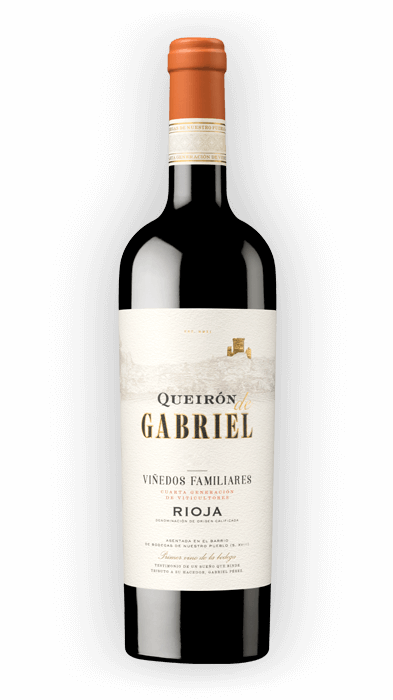
_about
graciano
Ampelographic characteristics
Aptitudes for cultivation
Good vigour and upright bearing. Tolerant to drought, it adapts well to all kinds of soils.
Sensitivity to diseases and adversities
Medium-high sensitivity to downy and powdery mildew. Prone to botrytis; very sensitive to the damp.
Oenological potential
Provides aromatic wines with a lively red colour and high acidity, used especially for making blends to achieve great longevity.
Training and pruning
It adapts to contained forms and short pruning.
Shooting period
Late.
Ripening period
Average-late.
Production

Vivai Cooperativi Rauscedo sca.
Queirón
vineyards
with graciano
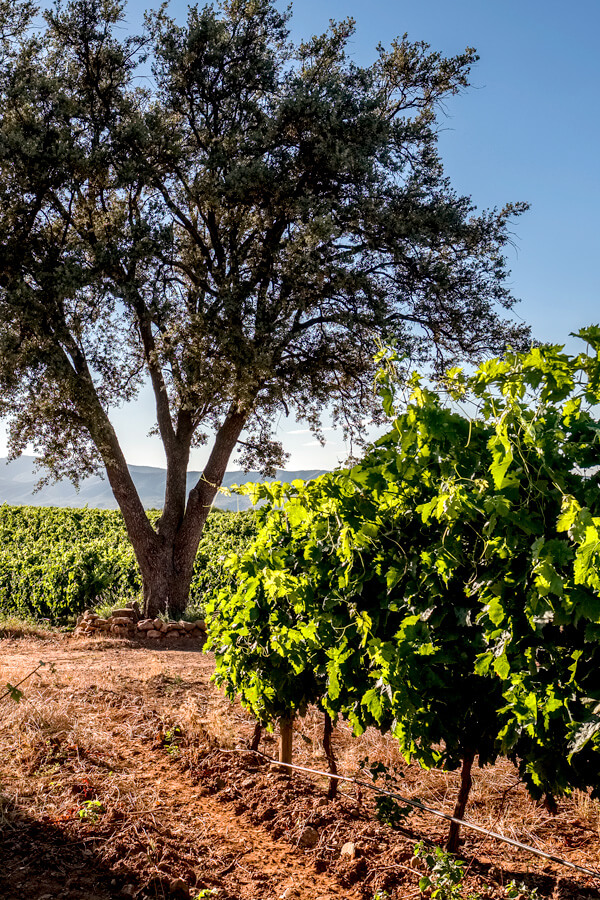
///viñedo de Quel ///graciano
El Pozo
Graciano's expression